If you have seen “STFU” in a text, comment section, or meme and were not sure what it actually means — you are in the right place. It is one of the most recognized pieces of internet slang out there, but it also causes plenty of confusion because its tone can shift dramatically based on context.
It can be rude, funny, sarcastic, or even a compliment depending on how and where it is used. This guide breaks down everything — the full form, origin, platform usage, and exactly how to respond when someone sends it your way.
What Does STFU Mean in Text & Chat?
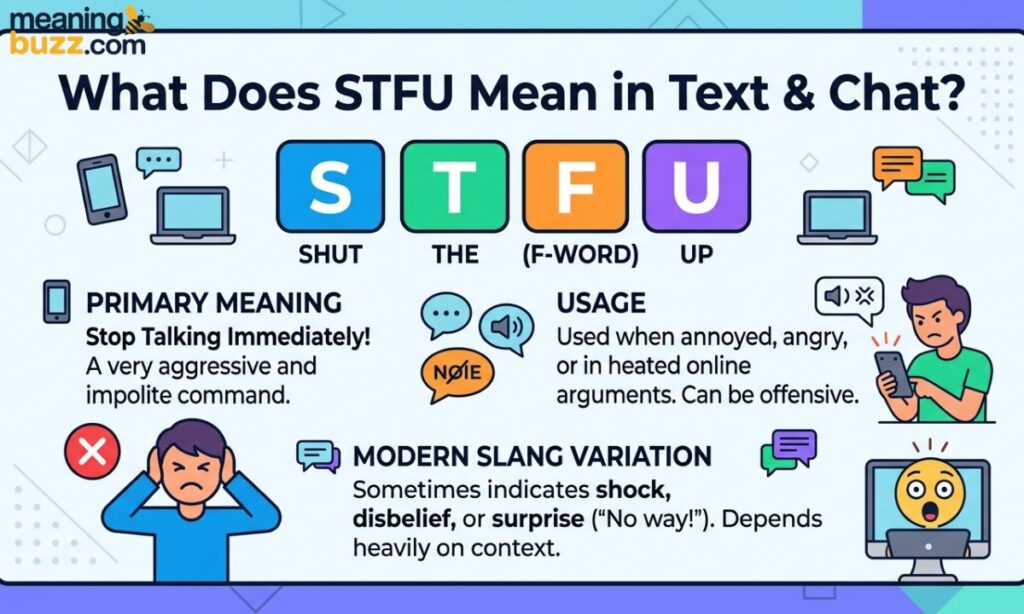
STFU stands for “Shut The F* Up.”** In text messages and online conversations, it is used to tell someone to stop talking — bluntly and directly. It can also pop up as a reaction to something shocking or unbelievable, where the person does not literally want you to stop talking but just cannot believe what you said.
Two main emotional uses:
- Angry or frustrated — telling someone to genuinely be quiet
- Shocked or playful — reacting to something surprising or funny with disbelief
STFU Stand For
STFU is an initialism, meaning each letter represents one word:
| Letter | Word |
| S | Shut |
| T | The |
| F | F*** |
| U | Up |
It can be written in uppercase (STFU) or lowercase (stfu). Uppercase tends to feel more intense and angry. Lowercase comes across as more dismissive or casual — like waving something off rather than yelling it.
Full Form, Stands For & Short Meaning of STFU
Full form: Shut The F*** Up
Short meaning: Stop talking — right now. Can be harsh or humorous depending on tone.
Also occasionally softened to: “Shut The Front Up” or “Shut The Freak Up” by people who want to use the term without the profanity. These are cleaner versions of the same idea and are used in situations where the original would feel too strong.
Origin, History & First Known Use of STFU
STFU has roots in the late 1990s, when early internet chat rooms, IRC servers, and forums like AOL Instant Messenger were at the center of online communication. Users needed to type fast, so long phrases got compressed into quick acronyms. “Shut the f*** up” was already a commonly used phrase in everyday speech, and it naturally became STFU in the digital world.
Key milestones in its history:
- Late 1990s — First appeared in early chat rooms and forum threads as a way to dismiss trolls or end arguments fast.
- Early 2000s — Spread through platforms like MSN Messenger, AIM, and early gaming communities.
- 2010–2015 — Memes and reaction GIFs embedded it into mainstream internet humor.
- 2015 onward — Instagram, Twitter, and TikTok pushed it into everyday Gen Z vocabulary.
- Today — It is a staple of casual online communication, recognized globally even by people who do not actively use profanity.
There is no single verified first use, which is common for organic internet slang. But it is well-documented across slang dictionaries including Urban Dictionary and Wiktionary as one of the most widely known online abbreviations.
STFU Mean In Instagram
On Instagram, STFU appears mainly in:
- Comment sections — reacting to something outrageous, funny, or unbelievable in a post
- Direct Messages — between close friends during playful banter
- Story replies — quick, emotional reactions to someone’s posted content
- Meme captions — where the phrase becomes part of the humor
On Instagram, the tone is usually humorous rather than genuinely angry. Someone commenting “STFU this is so good 😭🔥” on a video is not being rude — they are expressing shock and admiration in Gen Z style. Context and emojis completely change how it reads.
Also read TB Meaning in Text: Origin, Who Uses It, and How to Reply?
How People Use STFU in Daily Conversations?
Common Usage Styles
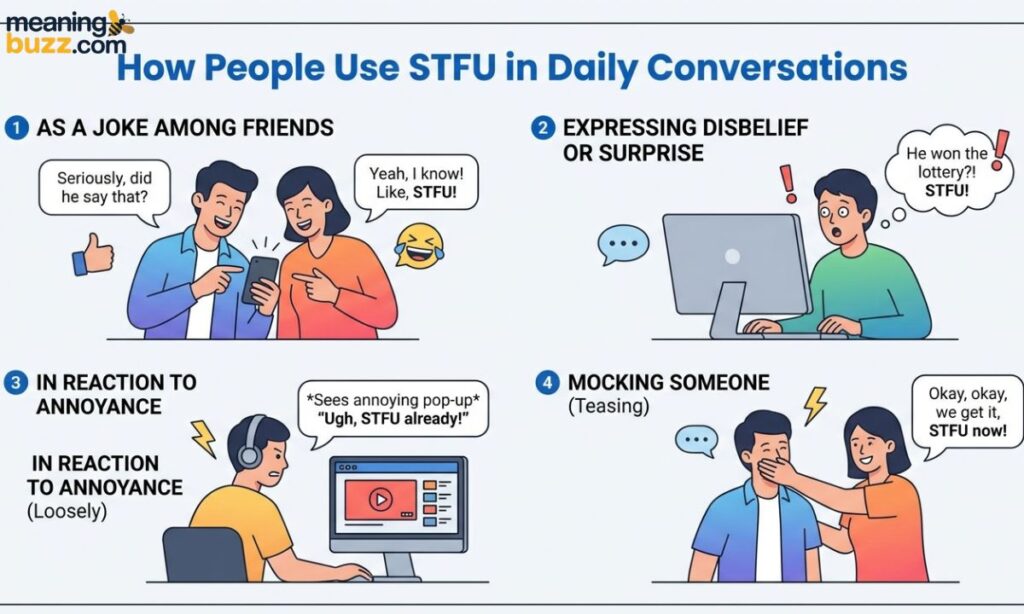
STFU shows up in a few distinct patterns in everyday online chat:
- As a sharp comeback to something offensive or over-the-top
- As a reaction of disbelief — “STFU, you actually got the job?!”
- As playful banter between close friends who tease each other regularly
- In meme culture as a caption or reaction image label
- In gaming chats directed at other players in competitive settings
Quick Examples
- “You seriously ate the whole pizza? STFU 😂”
- “STFU and just listen for a second.”
- “She said what?! stfu no way.”
- “stfu bro you’re overreacting.”
The lowercase version usually feels lighter. The uppercase version with an exclamation point feels much more intense.
STFU In Text From A Boy
When a boy sends STFU, the meaning falls into one of two categories:
- Joking and sarcastic — He is teasing you or reacting to something hilarious. Among guy friends especially, this is one of the most common uses. It signals humor, not real anger.
- Genuinely annoyed — If the conversation was already tense or argumentative, STFU from a guy might mean he is seriously done with the discussion.
The key difference is tone. If the rest of the messages are lighthearted and include emojis, the STFU is almost certainly playful. If the conversation was already heated, take it more seriously.
STFU Meaning Across WhatsApp, Instagram, TikTok & Snapchat
| Platform | Most Common Use | Typical Tone |
| Private chat between friends, playful banter | Casual, sometimes serious | |
| Comment reactions, meme captions, DMs | Humorous, sarcastic | |
| TikTok | Video comments, duet reactions, captions | Joking, expressive |
| Snapchat | Quick story replies, friend chats | Playful, fast |
On WhatsApp, STFU tends to show up in close friend group chats. It is used during funny conversations, heated debates, or when someone says something that genuinely surprises everyone. In family groups or professional chats, it should never be used.
Instagram’s comment culture makes STFU feel more like a reaction phrase than a direct insult. Seeing “STFU this outfit is everything 😭” under a fashion post is a compliment wrapped in slang — not an attack.
TikTok
TikTok thrives on fast, punchy reactions. STFU appears in comment threads constantly, usually as mock outrage, dramatic surprise, or exaggerated humor. The platform’s meme culture has made it almost a standard part of the reaction vocabulary.
Snapchat
On Snapchat, where messages disappear and conversations are very informal, STFU is usually a quick, funny reaction between people who know each other well. It rarely carries serious intent on this platform.
Different Meanings of STFU in Other Fields
Outside of texting and social media, STFU has one notable historical use:
- STFU (Southern Tenant Farmers Union) — A historical American labor organization from the 1930s. This is completely unrelated to modern internet slang but shares the same letters.
In technical, medical, or professional fields, STFU has no recognized formal meaning. If you ever see it in a professional document or report, it is likely either a typo or a copy-paste error from an informal source.
Common Confusions, Mistakes & Wrong Interpretations
Here are the most common ways people get STFU wrong:
- Thinking it is always aggressive — In Gen Z culture, it is often the opposite. It is frequently a sign of playful connection between friends.
- Using it with the wrong audience — Sending STFU to a parent, teacher, employer, or older relative is almost always going to land badly.
- Mistaking tone in text — Without facial expressions or voice tone, STFU can read much harsher than intended. Emojis help a lot.
- Confusing it with SU — “SU” (Shut Up) is a milder version. STFU carries more weight due to the profanity embedded in it.
- Assuming it is always literal — Often, STFU just means “wow, I can’t believe that” and has nothing to do with actually wanting someone to stop talking.
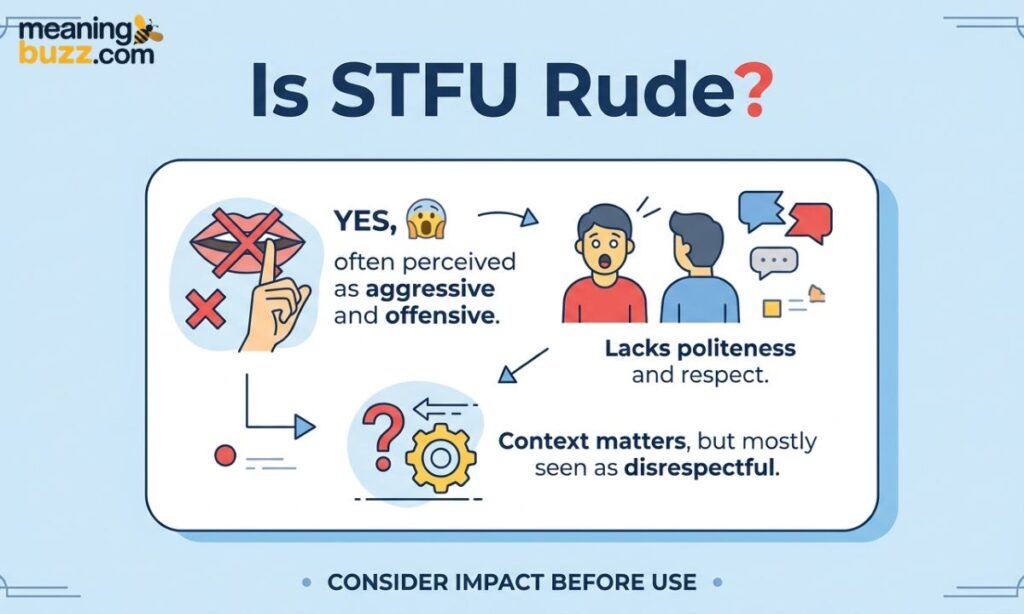
Is STFU Rude?
Short answer: it depends entirely on context and relationship.
- Between close friends — Usually playful, no offense taken or intended.
- Between strangers or acquaintances — Often comes across as rude and aggressive.
- In professional or formal settings — Always inappropriate, no exceptions.
- In response to something shocking or funny — More of an exclamation than an insult.
A good rule of thumb: if you would not say the full phrase out loud in that specific situation, do not type the acronym either. The letters carry the same emotional weight as the words.
Similar Terms, Alternatives & Related Slang
| Term | Meaning | Tone |
| SU | Shut Up | Milder, casual |
| STHU | Shut The Hell Up | Similar, slightly cleaner |
| BRB | Be Right Back | Neutral, exiting chat |
| SMH | Shaking My Head | Disbelief, disappointment |
| WTF | What The F*** | Shock, confusion |
| NGL | Not Gonna Lie | Honesty, candor |
| IKR | I Know Right | Agreement |
| GTF0 | Get The F*** Out | Disbelief, stronger reaction |
STFU fits naturally alongside WTF and SMH as part of the same family of emotionally charged internet acronyms.
Examples of STFU in Real Chat Situations
Example 1 — Disbelief:
Friend: “I got accepted into that program I applied for!” You: “STFU are you serious?! That’s insane 🎉”
Example 2 — Playful banter:
You: “I literally just woke up.” Friend: “stfu it’s 2 PM 😭”
Example 3 — Genuinely annoyed:
During an argument: “STFU, I already told you three times.”
Example 4 — TikTok comment:
Video caption: “Made this in 10 minutes.” Comment: “STFU how is this so good 🔥”
Example 5 — Sarcastic reaction:
“She really showed up two hours late and said traffic. stfu.”
How to Reply When Someone Says STFU?
Your reply depends entirely on the tone behind the message.
If Playful
- “Make me 😂”
- “Nope, I’m not done 😭”
- “Okay okay fine lmao”
- “You love it 🙃”
If Rude
- “That’s not okay to say.”
- “You can express that without the language.”
- Simply end the conversation — no response is also a valid reply.
- “I’d appreciate if you talked to me differently.”
Reading the tone before replying is everything. A casual “stfu 😂” in a meme thread deserves a funny comeback. A flat, cold “STFU” in an argument deserves a different, measured response.
Is STFU Still Popular? Trends & Online Usage
Yes — STFU is still very much in active use in 2026. It has moved beyond niche internet forums and is now part of mainstream Gen Z digital language. Its popularity is especially strong on TikTok, Discord, and Instagram, where fast, emotionally expressive reactions drive comment culture.
It is not fading away because it serves a very specific purpose — it captures strong emotion in four letters. As long as meme culture, group chats, and social media reactions exist, STFU will remain a go-to expression.
That said, its use is shifting. More people are now pairing it with emojis and GIFs to soften the edge, making it feel more like an exclamation than an insult. That evolution is probably what keeps it relevant.
Frequently Asked Questions
What does STFU stand for in text?
STFU stands for “Shut The F*** Up,” used to tell someone to stop talking or react to something shocking.
Is STFU always rude?
No — between close friends it is often playful and humorous, but it can be rude with strangers or in formal settings.
Can STFU be used as a compliment?
Yes — saying “STFU this is amazing” is actually a way to express extreme admiration in modern slang.
What is the difference between STFU and SU?
SU (Shut Up) is milder and less aggressive; STFU carries more emotional weight due to the profanity.
When did STFU first appear online?
It originated in late 1990s internet chat rooms and forums, spreading widely in the early 2000s.
Should I use STFU in professional messages?
Never — it is purely informal slang and completely inappropriate in any professional, academic, or formal setting.
How do I reply to STFU if I’m not sure if it was playful?
Match the tone with a light response like “lol okay” — if it was meant rudely, a calm boundary-setting reply works better.
Is STFU used differently by Gen Z?
Yes — Gen Z often uses it as an expression of shock, awe, or humor rather than genuine anger.
Conclusion
STFU is one of those internet acronyms that looks simple on the surface but carries a surprisingly wide range of meanings depending on context. At its core, it means “Shut The F*** Up” — but in practice, it can signal anything from genuine anger to over-the-top admiration. The difference comes down to tone, platform, relationship, and whether emojis are involved.
Understanding when STFU is playful versus when it is truly rude can save you from a lot of awkward misunderstandings online. Use it wisely — with the right people, on the right platforms, and with the right emojis. And if someone sends it your way, now you know exactly how to read it and how to respond.