You just got a message that says “WTH?!” and you are staring at the screen wondering what it means. You are not alone. WTH is one of the most searched texting abbreviations online, and for good reason — it pops up everywhere from group chats to TikTok comments.
The quick answer: WTH stands for “What The Heck” or “What The Hell.” It is used to express surprise, confusion, shock, or mild frustration in a fast and casual way.
This guide breaks down everything you need to know — meaning, history, usage by gender, platform differences, and when not to use it.
Definition and Meaning
WTH is a short texting acronym that people use all the time in messages, comments, and social media. It is simply a faster way to show surprise, confusion, or disbelief in a conversation. If you have ever seen WTH in a text and wondered what it means, this article will explain everything clearly.
It is one of those simple internet slang terms that has become very common in everyday online communication. Once you know what WTH means, you will start noticing it everywhere in your daily chats and posts.
What Does WTH Stand For?
WTH is a texting acronym with two common full forms:
| Version | Full Form | Tone |
| WTH (polite) | What The Heck | Mild, family-friendly |
| WTH (casual) | What The Hell | Slightly stronger, still common |
Both versions carry the same emotional punch. The difference is just how edgy you want to sound. “Heck” is safer around parents, teachers, or conservative audiences. “Hell” is more common in casual friend groups.
In everyday digital communication, WTH is used when something feels unexpected, confusing, or surprising. Think of it as a quick, three-letter way to say “I cannot believe this just happened.”
Background and History
WTH traces its roots back to the late 1990s when internet chat rooms and early SMS texting were taking off. Character limits made typing full phrases slow and impractical, so users started shortening popular expressions. “What the heck” was already a common spoken phrase in American English, so it naturally shrunk into WTH online.
By the early 2000s, platforms like AOL Instant Messenger and MySpace had made it mainstream. Then Twitter arrived with its 140-character limit, pushing short-form reactions like WTH even further into everyday use. Today it lives across every major platform — WhatsApp, Instagram, TikTok, Discord, and Snapchat — as a standard reaction emoji substitute.
What Does WTH Mean on Snapchat?
On Snapchat, WTH is used to react quickly to a surprising snap, a shocking story, or unexpected news from a friend. Because Snapchat conversations are fast and disappear quickly, short abbreviations like WTH are the norm.
You will most often see it in:
- Reply to a wild photo or video snap
- Group chat reactions to something unexpected
- Playful back-and-forth when something funny or shocking happens
Example: “She just showed up with a new haircut and WTH it actually looks amazing.”
WTH Meaning from a Guy
When a guy sends WTH, it is usually a raw, unfiltered reaction. Men tend to use it to express genuine shock or confusion without over-explaining their feelings. It could mean:
- He is genuinely surprised by something you said
- He is mildly annoyed but keeping it light
- He finds something funny and is reacting to it playfully
Pay attention to tone cues. If he adds emojis like 😂, he is laughing. If there are no emojis and the message is short, he might be more serious about his confusion or frustration.
WTH Meaning from a Girl
When a girl sends WTH, it tends to carry a more expressive or emotional tone. Girls often use it to show:
- Disbelief at something unexpected
- Playful shock in a fun conversation
- Mild irritation when something does not make sense
Example: “You forgot my birthday? WTH!” Here it is clearly frustration. But “WTH you look so good in that photo 😭” flips the script into a compliment wrapped in shock.
Context is everything. Read the surrounding message, not just the abbreviation.
Usage in Various Contexts
WTH is flexible. Here is how it shifts tone depending on where and how it is used:
- Everyday texting: “WTH happened at the party last night?” — casual confusion
- Social media comments: “WTH, this cat just opened the fridge.” — humorous shock
- Gaming chats: “WTH was that move?!” — competitive frustration
- Meme captions: Often paired with a reaction image for humorous effect
- Dating apps: Used playfully to show interest or surprise in early conversations
Also read White Heart Emoji: What It Really Says in a Message
Common Misconceptions and Clarifications
A few things people often get wrong about WTH:
- It is not always angry. WTH can be playful, funny, or even a compliment depending on context.
- It is not the same as WTF. WTF is stronger, more explicit, and less appropriate in wider settings. WTH is the toned-down version.
- It is not always serious. In most casual conversations, WTH is lighthearted, not hostile.
- It does not always need a dramatic reply. Sometimes a laughing emoji or “right??” is all you need in return.
Similar Terms and Alternatives
If WTH does not fit the moment, here are close alternatives:
| Slang | Meaning | Tone |
| WTF | What The F*** | Stronger, more explicit |
| OMG | Oh My God | Surprise or excitement |
| SMH | Shaking My Head | Disappointment or disbelief |
| LOL | Laugh Out Loud | Humor, light reaction |
| Huh? | Simple confusion | Neutral and mild |
| What on earth? | Formal surprise | Polite, no profanity |
Is WTH a Bad Word?
WTH is generally not considered a bad word. It is mild, widely accepted, and much softer than stronger alternatives. That said, context still matters:
- Around close friends: Completely fine
- Around family or older adults: “Heck” version is safer
- In religious or conservative settings: Even “heck” might raise eyebrows for some
- Around children: Best to avoid or explain clearly
The bottom line is that WTH sits in the mild slang category. Most people would not even blink at it in casual conversation.
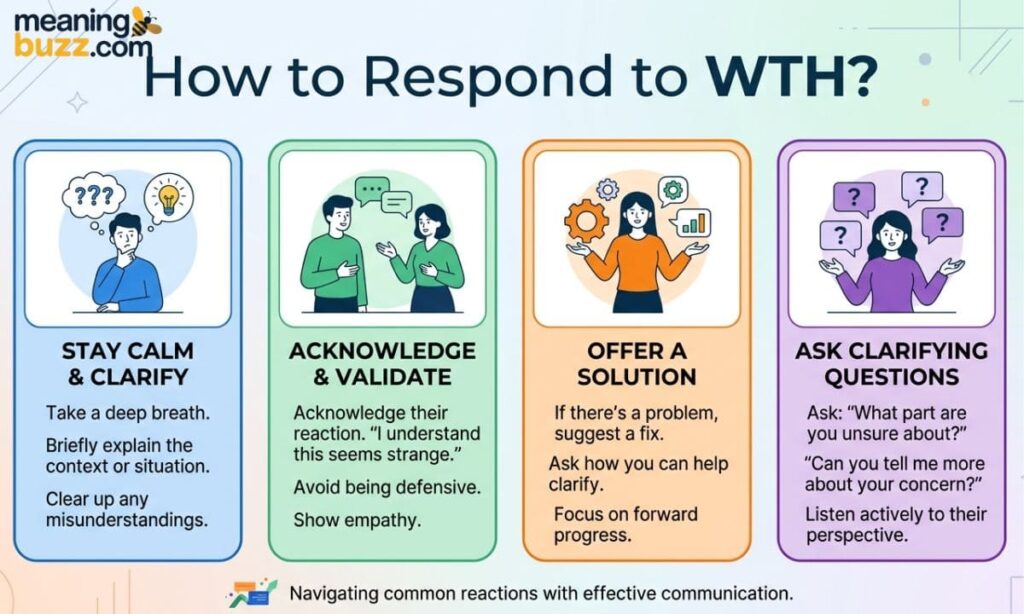
How to Respond to WTH?
Your reply depends entirely on the tone the sender used. Here are some simple response options:
- If it is playful: Match the energy — “I know right?? 😂”
- If it is confused: Explain yourself — “Sorry, let me clarify what I meant.”
- If it is frustrated: Acknowledge their reaction — “Fair reaction, I should have told you earlier.”
- If you are unsure of the tone: Ask directly — “Everything okay?”
Do not overthink it. WTH is usually casual. Match the energy, keep it short, and move the conversation forward.
Regional or Cultural Differences
WTH started as American English slang but has spread globally thanks to social media. Here is how different regions use it:
- United States: Most common; both “heck” and “hell” versions are used depending on region
- United Kingdom: Less common; locals often prefer “What on earth?” or “Bloody hell?” but understand WTH online
- Australia: Understood but sometimes replaced by “What the?” in casual speech
- India: Popular among bilingual youth who blend it into Hinglish conversations
- Latin America: Spanish speakers use WTH in English-heavy apps alongside local expressions
Comparison with Similar Terms
| Term | Full Form | Intensity | Best Used For |
| WTH | What The Heck/Hell | Mild | Casual surprise or confusion |
| WTF | What The F*** | Strong | Close friends, edgier settings |
| OMG | Oh My God | Medium | General excitement or shock |
| SMH | Shaking My Head | Mild | Disappointment, not shock |
WTH sits perfectly in the middle — expressive enough to convey real emotion, clean enough to use in most situations.
Usage in Online Communities and Dating Apps
In Reddit threads, Discord servers, and gaming communities, WTH is a daily staple. Gamers type it mid-match when something unexpected happens. Reddit users drop it under shocking posts or wild news threads.
On dating apps like Tinder or Bumble, WTH keeps early conversations lively. It shows genuine reaction without sounding too intense. A simple “WTH you’re actually hilarious 😂” can land perfectly as a flirty, low-pressure compliment.
Hidden or Offensive Meanings
WTH does not carry any hidden or deeply offensive meaning in standard use. The only time it edges into offensive territory is when “hell” is used around people who find that word religiously or personally uncomfortable. There is no secret slang meaning attached to it — what you see is what you get.
Suitability for Professional Communication
Short answer: avoid WTH in formal or professional settings.
- Formal emails: Never appropriate
- Client conversations: Too casual, can seem unprofessional
- Internal team chats between close colleagues: Possibly fine if the culture is relaxed
- Official documents or reports: Completely inappropriate
A real example of why this matters: a marketing intern once sent his manager a Slack message saying “WTH is this campaign?” He meant genuine confusion. His manager read it as anger. It led to an awkward meeting. Lesson learned — in professional spaces, say what you mean clearly.
Frequently Asked Questions
What does WTH mean in a text?
WTH means “What The Heck” or “What The Hell,” used to express surprise, confusion, or mild frustration.
Is WTH offensive?
Generally no. It is mild slang, though the “hell” version may offend in conservative or religious settings.
What is the difference between WTH and WTF?
WTH is the softer, more acceptable version. WTF is explicit and much stronger in tone.
Can I use WTH at work?
Only in very casual internal chats with people you know well. Avoid it in emails or formal communication.
What does WTH mean on Snapchat?
It means the same thing — surprise or shock — used in quick, casual snap reactions.
Does WTH always mean someone is angry?
No. It can be playful, humorous, or even a compliment depending on context and tone.
Is WTH appropriate for kids?
It is mild, but it is still informal slang. Best to explain what it means rather than encouraging young kids to use it regularly.
Conclusion
WTH is three letters that pack a lot of emotional range. It can mean genuine confusion, playful shock, mild irritation, or even a surprised compliment depending on how it is used. Understanding the context behind it is what turns a confusing message into a clear one.
Use it freely in casual conversations with friends. Be careful around professional settings, older adults, or anyone who might read the “hell” version as harsh. And when someone sends it to you, match their energy and keep the conversation flowing.
Now that you know exactly what WTH means, you can read it and respond to it with full confidence.