You’re mid-conversation and someone replies with just “TMI.” Suddenly you’re second-guessing the whole exchange. Was that rude? Was it a joke? Did you say something wrong? If this sounds familiar, you’re in good company — TMI meaning in text is one of the most searched slang terms online, and for good reason. It’s everywhere, from WhatsApp group chats to TikTok comment sections, and it doesn’t always land the same way twice.
This guide gives you everything you need to understand it, use it right, and never feel caught off guard again.
Meaning & Definition
TMI stands for “Too Much Information.” It’s used when someone shares details that are overly personal, unnecessarily graphic, or just more than the situation called for. Think of it as a polite — or playful — way to say, “Okay, I really didn’t need to know that.”
It’s not always negative. In most casual conversations, TMI is lighthearted and humorous. Among close friends, it’s practically a badge of comfort — you only drop a TMI on someone you trust enough to overshare with.
TMI Meaning in Slang
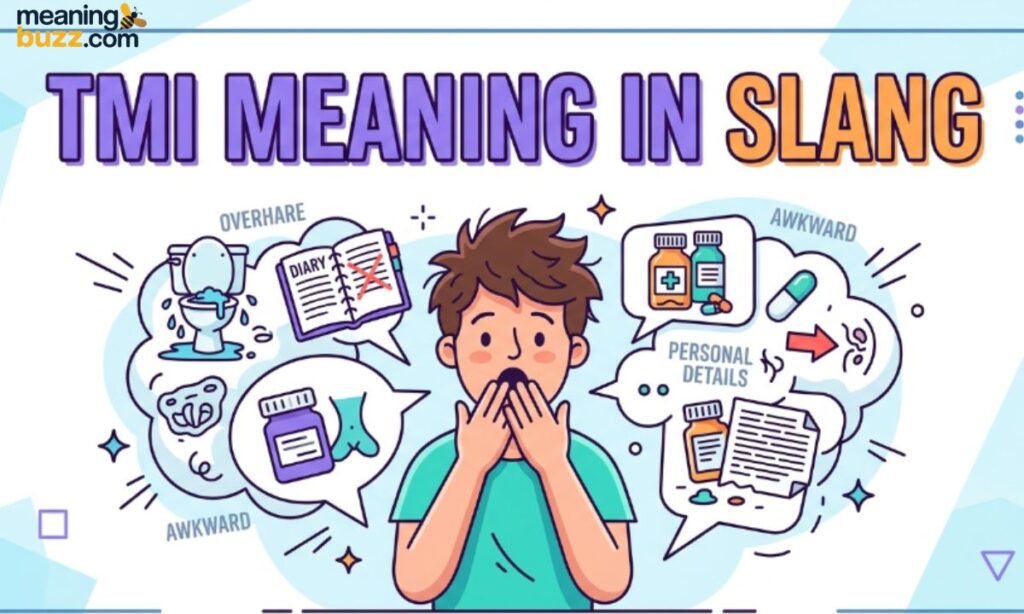
In internet slang, TMI is used to react to oversharing in real time. It’s punchy, expressive, and requires zero explanation once you know what it means.
Common ways it shows up:
- “I just woke up and my nose was full of —” / “TMI!! 😭”
- “Let me tell you every single detail of my breakup…” / “Lol TMI but go off”
- “My stomach has been doing weird things since Tuesday” / “TMI dude, just say you’re sick 💀”
The tone shifts based on emojis and punctuation. “TMI 😂” is playful. “TMI.” with a period feels colder. Always read the full message, not just the acronym.
Background
The phrase “too much information” existed in everyday speech long before texting was a thing. The abbreviation TMI gained momentum in the late 1990s and early 2000s, driven by internet chat rooms and early forums where fast reactions needed short expressions. By the time smartphones and social media took over, TMI was already a fixture in digital culture — right up there with LOL and BRB.
Unlike many slang terms that come and go with trends, TMI has remained consistent in meaning for over two decades. Its staying power comes from a simple truth: people will always overshare, and others will always need a quick, kind way to call it out.
Usage in Different Contexts
Chat & Social Media
In everyday texting and social media, TMI is almost exclusively used as a reaction to oversharing. It’s casual, often funny, and rarely intended to hurt feelings.
| Situation | Example | Tone |
| Friend overshares health details | “TMI, but are you okay?” | Caring + playful |
| Someone gives too much backstory | “Okay TMI, just tell me the result 😅” | Light teasing |
| Gross or awkward detail | “TMI!! I didn’t need that visual 😭” | Shocked + humorous |
| Reacting to oversharing in public posts | “Girl… TMI for the internet 💀” | Slightly sarcastic |
Professional Fields
In workplaces or formal settings, TMI rarely appears in writing. When it does, it’s still shorthand for “that’s more detail than we needed,” often said verbally or in internal casual chats — never in emails or reports.
What Does TMI Mean on Snapchat?
On Snapchat, TMI appears in DMs and story replies. Since Snapchat encourages more raw, unfiltered moments, it’s common for someone to overshare in a snap or voice note, and the reply comes back: “Lmao TMI 😭.” The platform’s casual vibe makes TMI feel less harsh and more like friendly banter.
Also read WYTB Meaning in Text: Your Ultimate Guide to This Chat Acronym
TMI Meaning in Text from a Guy
When a guy sends “TMI,” he’s usually reacting with humor or mild shock. It’s rarely hostile — more often it’s his way of saying he’s surprised you went there, and he’s fine with it. It can also be a sign of comfort; he wouldn’t bother saying it if he weren’t engaged in the conversation.
TMI Meaning in Text from a Girl
From a girl, TMI tends to carry a similar energy — playful and expressive. She might use it to tease, to laugh, or to gently redirect the conversation. A “TMI bestie 😭” is pure affection. A flat “TMI.” might mean she’s genuinely a bit caught off guard. Emojis are your best guide.
Meaning in Chat, WhatsApp, Instagram, and TikTok
TMI travels across platforms with consistent meaning but slightly different vibes:
- WhatsApp: Appears in personal and group chats, usually among people who know each other well. Casual and warm.
- Instagram: Shows up in DMs or comment replies when someone’s caption or story gets a little too personal.
- TikTok: Used in comments reacting to creators who overshare. Can feel more public and slightly sharper in tone.
- Twitter/X: Common in reply threads when someone gives way too much context in a 280-character world.
TMI Meaning in K-Pop
This is where things get interesting. In K-pop culture — especially in Korean variety shows, fan cams segments, and idol interviews — TMI is used differently. While the acronym still technically stands for “Too Much Information,” Korean fans and idols use it to mean random, trivial, or funny personal facts, not necessarily uncomfortable ones.
An idol might say “TMI, but I ate two bowls of rice this morning” and the audience laughs — not because it’s awkward, but because it’s charmingly pointless. Some fans even suggest that in Korea, TMI stands for “Tell Me Information,” reflecting how it’s used as an invitation to share quirky everyday details rather than a reaction to oversharing. International fans are often confused when their favorite idols’ TMIs sound so tame — now you know why.
Meaning in Physics, Medical, and Aircraft Terminology
Outside of texting, SMT has technical counterparts worth knowing:
- Physics: TMI can refer to Transverse Magnetic Isotropy, describing specific properties in magnetic field research.
- Medical: In clinical settings, TMI may appear informally to describe when patients or professionals share excessive or unnecessary clinical detail beyond what’s needed for diagnosis.
- Aviation/Aircraft: TMI can stand for Total Mission Index or appear in operational planning documents within aviation management systems.
None of these ever appear in casual texting. If you see TMI in a chat, it’s slang — full stop.
Common Misconceptions
A few myths that keep floating around:
- “TMI is always rude” — It’s not. Most of the time it’s playful, especially among friends.
- “TMI means the person is annoyed” — Context and tone determine that. An emoji changes everything.
- “TMI works in professional settings” — Avoid it in formal communication. Stick to full words.
- “TMI is new slang” — It’s been around since the internet was young. It’s a classic.
Quick tip: if someone sends you TMI with a laughing emoji, they’re not upset — they’re amused.
Similar Terms & Alternatives
| Term | Meaning | How It Compares to TMI |
| NMK | Not My Kind | Preference-based, not reaction to oversharing |
| SMH | Shaking My Head | Reacts to disbelief or poor choices |
| LMAO | Laughing My Head Off | Pure humor, no boundary-setting |
| BRB | Be Right Back | Logistical, totally different |
| NSFW | Not Safe for Work | Warns about content, doesn’t react to it |
| “That’s personal” | Full phrase | More formal way of expressing the same idea |
How to Respond to TMI?
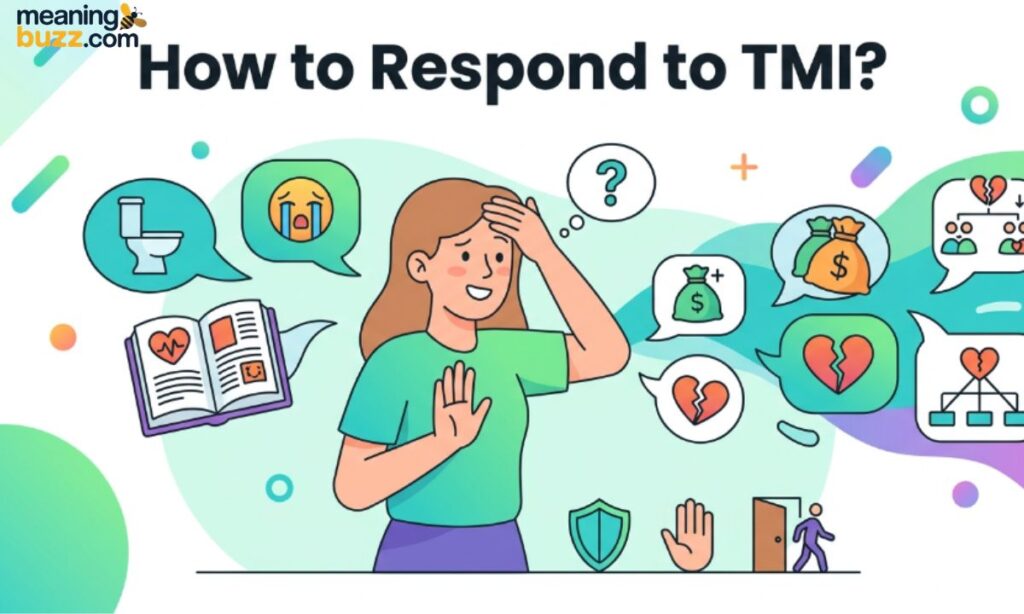
Getting a TMI reply doesn’t have to be awkward. Here’s how to handle it:
If it’s playful:
“Lol okay I’ll keep that to myself next time 😂”
If you’re unsure of the tone:
“Haha fair enough, moving on 😅”
If you want to own it:
“No regrets, you needed to know 😎”
The worst thing you can do is get defensive. TMI is almost never a personal attack — it’s a reaction. Laugh it off and keep the conversation going.
Differences from Similar Words
- TMI vs. SMH: SMH (shaking my head) expresses judgment or disappointment. TMI reacts specifically to oversharing personal details.
- TMI vs. NSFW: NSFW warns people before they see content. TMI reacts after someone has already shared too much.
- TMI vs. “that’s personal”: TMI is casual and often funny. “That’s personal” is more serious and direct.
Relevance in Online Conversations & Dating Apps
On dating apps, TMI can be a delicate signal. Early in a conversation, someone might drop a personal detail that’s a bit too heavy — health history, family drama, financial stress — and a gentle “haha TMI but I hear you 😊” is a soft way to redirect without making it awkward. It signals awareness of social boundaries while keeping the conversation light.
In friend groups and comment sections, TMI keeps interactions fun. It’s a shared language that says, “We’re close enough that I can call this out, and we’ll both laugh about it.” That’s the core social value of the term — it holds a boundary without building a wall.
Frequently Asked Questions
What does TMI mean in a text?
TMI means “Too Much Information” — used when someone shares overly personal or unnecessary details in a conversation.
Is TMI rude to say?
Usually not — it depends on tone. With a laughing emoji, it’s playful. Without one, it can feel blunter.
Can TMI be used as a compliment?
In a way, yes. Among friends, it shows comfort and closeness that you can overshare without judgment.
What does TMI mean in K-pop?
In K-pop culture, TMI refers to random, quirky personal facts shared by idols — lighter and less awkward than the Western interpretation.
Is TMI still used in 2026?
Absolutely. Oversharing hasn’t gone anywhere, and neither has TMI — it’s a digital classic that continues to appear across all major platforms.
Should I use TMI in professional messages?
No. Always use full words and formal language in work communication.
Conclusion
TMI has earned its place as one of the most enduring pieces of internet slang for a simple reason — it solves a real social problem with humor.
Whether you’re reacting to a friend’s accidental overshare, watching a K-pop idol casually reveal what they had for breakfast, or gently redirecting a conversation on a dating app, TMI gets the job done in three letters. Now that you know every angle of its meaning, you’re fully equipped to use it naturally — and respond to it without a second of hesitation.