You are scrolling through your messages, and someone replies with just “tsk.” No explanation. No context. Just those three little letters. What does it mean? Are they annoyed? Joking? Judging you?
You are not alone in wondering. TSK is one of the most searched slang terms online right now — and understanding it can save you from a lot of awkward misread moments. This guide breaks down TSK meaning in text, chat, Instagram, TikTok, and more, with real examples, usage tips, and everything you need to know.
TSK Meaning
TSK is not an abbreviation. It does not stand for any specific phrase or set of words. Instead, it is an onomatopoeic expression — a written version of the actual sound people make by clicking their tongue against the roof of their mouth.
That “tsk” sound is something humans have used for centuries in real-life speech to express:
- Mild disapproval
- Disappointment
- Annoyance or impatience
- Playful scolding
- A “I told you so” reaction
When someone types “tsk” in a text or comment, they are essentially writing out that tongue-click sound to show a quick emotional reaction — without needing a full sentence.
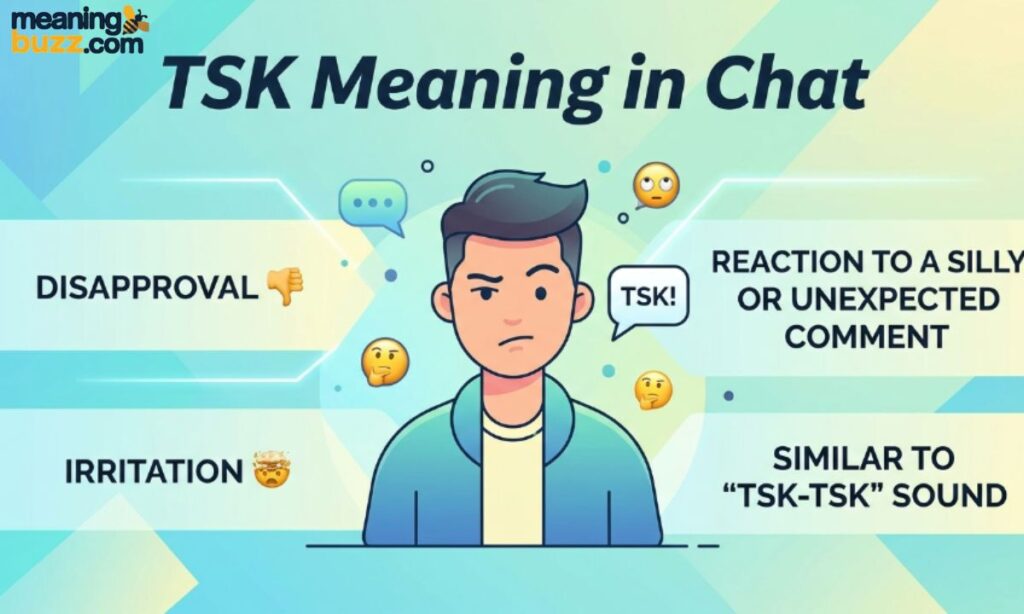
TSK Meaning in Chat
In chat conversations, TSK works as a non-verbal cue — it replaces a facial expression or a real-life sound with just three letters. The tone behind it shifts depending on the situation.
Here is a simple breakdown of how TSK is used in different contexts:
| Context | TSK Tone | Example |
| Between close friends | Playful, teasing | “Tsk, you forgot again 😏” |
| Reacting to a mistake | Mild disappointment | “Tsk… really?” |
| Responding to drama | Sarcastic, amused | “Tsk tsk, here we go” |
| Self-directed | Acknowledging fault | “TSK… I deserved that” |
| Parental/authority tone | Light scolding | “Tsk tsk, kids.” |
The key takeaway: TSK is usually soft and emotional, not harsh or aggressive. Context and tone decide everything.
TSK Meaning in Text Slang
In the world of text slang, TSK sits alongside expressions like “smh,” “ugh,” and “sigh.” All of them capture emotions without needing long explanations. What makes TSK unique is that it imitates an actual physical sound rather than spelling out a feeling.
In text slang culture, especially among Gen Z and millennials, TSK is often layered with sarcasm, irony, or affectionate teasing. It signals that the sender is reacting emotionally but keeping it casual and light.
Where Is TSK Commonly Used?
Most Common Platforms
TSK appears across nearly every major digital platform. Here is where you will encounter it most often:
- WhatsApp and iMessage — Personal chats where friends tease each other
- Instagram — Comments and DMs reacting to posts or Reels
- TikTok — Comment sections with mock disapproval or playful criticism
- Discord — Gaming and group chats where reactions are fast and short
- Twitter / X — Quote tweets or replies expressing irony
- Snapchat — Casual reactions to stories or snaps
Tone
The tone of TSK is almost always light and informal. It is rarely used to express deep anger or serious criticism. Think of it as the written equivalent of raising an eyebrow or clicking your tongue at a friend who just said something ridiculous.
In professional environments, TSK should be avoided. It can easily come across as passive-aggressive or condescending to someone who does not know you well.
Also read IK Meaning in Text, Chat & Discord: The Real Answer
TSK Meaning on Instagram
On Instagram, TSK shows up in:
- Comment sections reacting to funny or cringeworthy Reels
- DMs between friends responding to stories
- Reply threads where users lightly roast each other
It is often paired with emojis like 😒, 😏, or 🙄 to make the tone clearer. A comment like “Tsk tsk 😏” under a silly post signals teasing rather than genuine criticism.
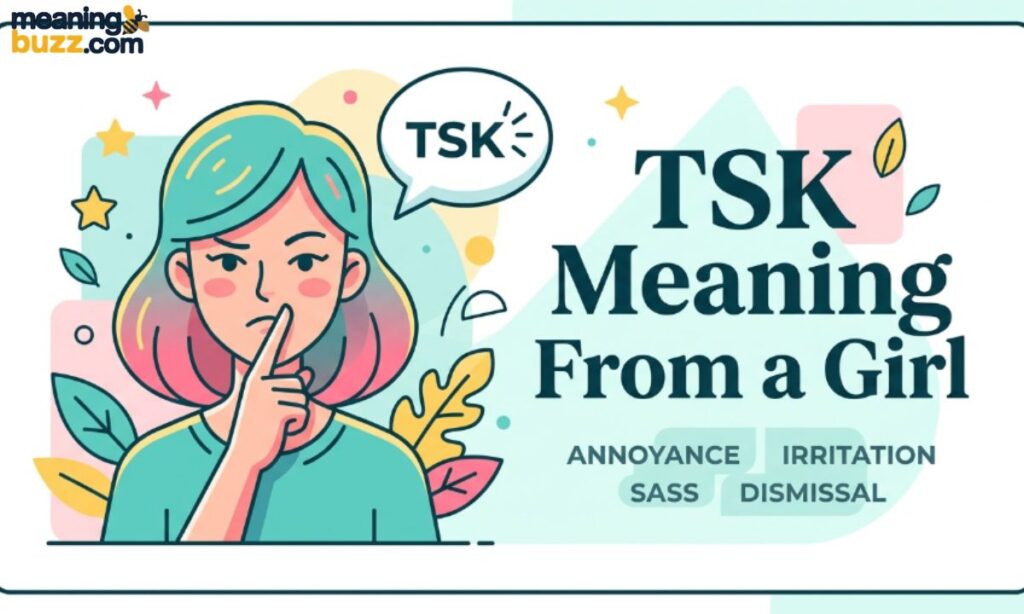
TSK Meaning From a Girl
When a girl uses TSK in a conversation, the meaning does not change — but the emotional undertone can vary.
- If she uses it playfully with emojis, it is likely flirtatious teasing
- If she uses it after you forgot something important, it likely signals mild disappointment
- If she uses “tsk tsk” (repeated), she is probably joking but making a point
The golden rule: read the rest of her message. TSK never stands alone in meaning — the context around it tells you everything.
TSK Meaning on TikTok
TikTok has helped revive and spread TSK as a reaction term. On TikTok, you will see it:
- In comment sections reacting to someone’s fail or mistake in a video
- Combined with laughing emojis to keep the tone humorous
- Used in caption-style reactions on Duets or Stitches
- As a short, expressive response to drama or trending content
TikTok’s fast-moving comment culture is perfect for TSK — it is quick, expressive, and emotionally clear without slowing down the scroll.
Examples of TSK in Conversation
Here are real-style conversation examples to show how TSK works naturally:
Example 1 — Playful Teasing
Alex: “I stayed up until 3 AM watching Netflix again.” Sam: “Tsk tsk. And then you wonder why you’re tired.”
Example 2 — Mild Disappointment
Friend: “I told you I’d call back and then… didn’t.” You: “Tsk. Classic you.”
Example 3 — Self-Aware Guilt
Girlfriend: “You forgot my birthday dinner 😒” Boyfriend: “TSK… I deserve that.”
Example 4 — TikTok Comment
Video shows someone tripping on stage Comment: “Tsk tsk 😭😂 bro was NOT ready”
Example 5 — Playful Scolding
Group chat: “Who ate the last slice?” Mom: “Tsk tsk. You all know the rules.”
When to Use and When Not to Use TSK
When to Use
- With close friends or people who know your humor
- In casual group chats where the tone is already playful
- Reacting to light mistakes, funny situations, or gentle teasing
- On social media comment sections where sarcasm is expected
- When you want a reaction that feels human and emotional without typing a paragraph
When Not to Use
- In professional emails, Slack messages with clients, or formal chats
- When someone shares genuinely sad news — “tsk” sounds cold and dismissive
- With people you do not know well, since tone can easily be misread
- When you mean something seriously — TSK can undercut a message you want taken literally
- In sensitive conversations where emotional clarity matters
Similar Slang Words or Alternatives
If TSK does not fit the mood, here are similar expressions you can use:
| Slang | Meaning |
| SMH | Shaking my head — disbelief or disappointment |
| Ugh | Frustration or annoyance |
| Sigh | Resignation or tiredness |
| Tsk tsk | Stronger version of TSK — more scolding |
| Pfft | Dismissing something as unimportant |
| Hmpf | Huffy or annoyed reaction |
| Oh come on | Gentle disbelief |
| Really? | Sarcastic or surprised reaction |
Is TSK Still Popular?
Yes — and it is actually growing. In 2026, short emotional reactions like TSK fit perfectly into the minimalist texting trend popular with Gen Z. One small word or sound now replaces full sentences in digital conversations.
TSK has survived because it is versatile. It works as a tease, a reaction, a light scolding, or a sarcastic comment. Unlike many slang terms that fade quickly, TSK carries actual phonetic meaning rooted in real human behavior — and that keeps it relevant.
TSK Meaning in English and Online Culture
In standard English, “tsk” has always been recognized as an interjection — a sound that expresses feeling rather than information. It appears in classic literature, older TV shows, and everyday speech.
What the internet did was digitize it. Online culture turned a spoken sound into typed shorthand, and it spread naturally because it was already familiar to people across cultures and languages. Today, TSK sits at the intersection of traditional language and modern slang — old enough to feel natural, short enough to fit digital communication perfectly.
Frequently Asked Questions
What does TSK mean in texting?
TSK represents a tongue-clicking sound used to express mild disapproval, disappointment, or playful teasing in text conversations.
Is TSK an abbreviation?
No. TSK is not short for any phrase — it is an onomatopoeic word that imitates a real-life sound.
What does tsk tsk mean compared to tsk?
Tsk tsk is simply a more dramatic, drawn-out version of the same reaction, showing stronger disappointment or a more exaggerated scolding tone.
What does TSK mean from a girl?
It usually means playful teasing or mild disappointment — the exact tone depends on context, emojis used, and the relationship dynamic.
Is it okay to use TSK at work?
Generally no. It can sound passive-aggressive or sarcastic in professional settings. Stick to casual chats with people who already know your tone.
Is TSK positive or negative?
It leans slightly negative in meaning, but it is most often used in a light, humorous, or affectionate way rather than as a serious criticism.
What is the difference between TSK and SMH?
SMH (shaking my head) expresses disbelief or embarrassment. TSK is more of a direct, vocal-style judgment or teasing reaction.
Can TSK be used sarcastically?
Yes — in fact, sarcastic use is one of the most common ways TSK appears in online conversations, especially on TikTok and Instagram.
Conclusion
TSK is one of those tiny expressions that carries more weight than its three letters suggest. Whether it is a playful tease between friends, a mock-disappointed comment on TikTok, or a light reaction in a group chat, TSK communicates something real and human — the tongue-click reaction that people have used long before the internet existed.
Now that you know its meaning, tone, and when to use it, you can read and use TSK with confidence. Just remember: context is everything. The same three letters can be affectionate with a close friend and awkward in the wrong conversation. Use it wisely, keep it casual, and let the tone do the work.