Ever received a message saying “you’re dry” and felt completely lost? You’re not the only one. This phrase has taken over group chats, DMs, and comment sections — and if you don’t know what it means, conversations can get awkward fast.
Whether someone said it to you, you saw it on TikTok, or you’re just curious about modern texting slang, this guide breaks it all down in plain language.
What Is the Meaning of “You’re Dry”?
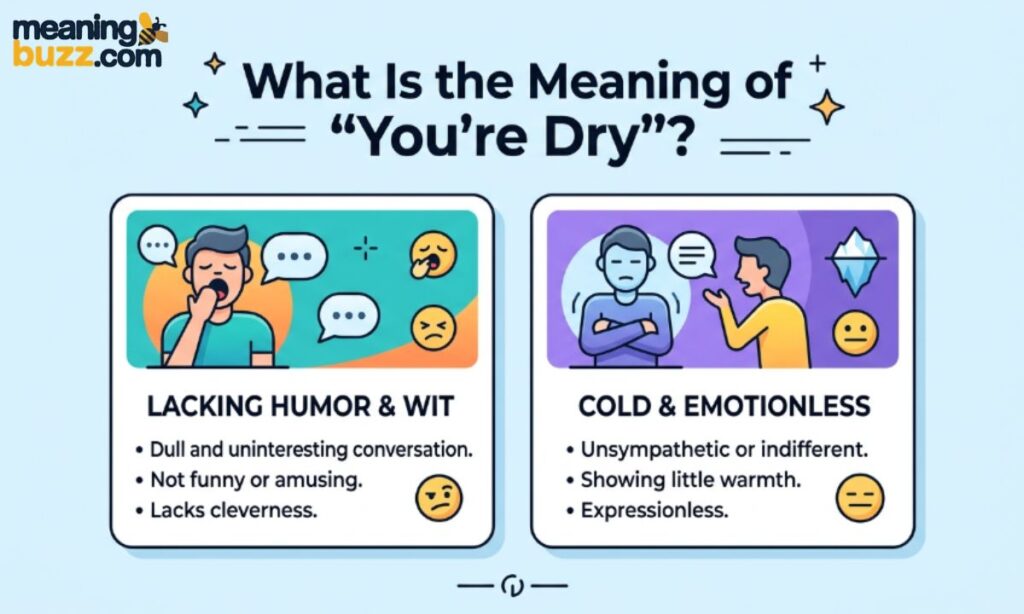
In texting and online chat culture, “you’re dry” means your messages are boring, flat, or low-effort. It has nothing to do with being thirsty or the weather. It’s a slang term used to call out someone whose replies feel lifeless — think one-word answers, zero questions back, and no real energy in the conversation.
The phrase is technically “you’re dry” (a contraction of “you are dry”). You’ll often see it written as “your dry,” which is grammatically incorrect but extremely common in casual texting.
In plain terms:
- You’re dry = Your replies are dull and unenthusiastic
- You’re dry = You’re not making any effort to keep the conversation going
- You’re dry = Your messages feel cold, distant, or emotionless
It’s closely linked to the term “dry texting,” which Cambridge Dictionary added to its vocabulary in late 2025, defining it as sending very short messages that may suggest the sender is not interested.
Where Is “You’re Dry” Commonly Used?
This slang pops up across almost every major messaging and social platform. Here’s where you’ll see it most:
| Platform | How It’s Used |
| WhatsApp / iMessage | Called out in personal one-on-one chats |
| Instagram DMs | Used when someone gives a flat reply to your story or message |
| TikTok Comments | Dry responses to funny videos often get roasted publicly |
| Snapchat | Used when someone’s streak reply is just a blank photo or “lol” |
| Twitter / X | Quoted replies that feel underwhelming get labeled as dry |
It’s most common among Gen Z and millennials, and it’s almost always used in informal, casual settings. You will not find it in work emails — at least not yet.
Dry Meaning in Chat From a Guy
When a guy tells you “you’re dry,” the interpretation depends heavily on context and your relationship with him.
- If it’s a friend: It’s almost always playful teasing. He’s nudging you to be more fun or entertaining.
- If it’s someone you’re talking to romantically: He might be signaling that he’s not feeling enough energy or effort from your side.
- If it comes with a laughing emoji: Light, harmless, not a big deal.
- If it’s said seriously with no emoji: He may genuinely feel like the conversation is one-sided.
Men in digital spaces also get called dry. If a guy replies with “k” or “yeah” repeatedly and never asks follow-up questions, someone will likely tell him he’s dry, too. It goes both ways.
Also read TH Meaning Explained in Text, Chat & Social Media Use
What Does It Mean to Have a Dry Personality?
Being called “dry” in a text is different from being called a dry person overall. A dry personality in slang refers to someone who:
- Rarely shows excitement or enthusiasm in conversation
- Makes jokes without any expression (sometimes called “deadpan”)
- Responds to almost everything with short, unemotional answers
- Doesn’t pick up on social cues or match the energy of those around them
Interestingly, having a “dry personality” isn’t always negative. Some people find dry humor genuinely funny — the kind of humor that’s delivered with a straight face and zero flair. Think of it as the opposite of being overly expressive or dramatic.
However, in the context of texting slang, dry personality usually leans negative — it means someone who is consistently low-energy and hard to connect with digitally.
“We Are Dry” Meaning
“We are dry” is a less common phrase but it does appear in chats. It typically means:
- The conversation between both of you has become flat and boring — neither side is putting in effort.
- Both people are stuck in a texting rut — same old small talk with no real depth.
- The relationship (romantic or friendly) has lost its spark — there’s no longer exciting exchange happening.
Someone might say “we are dry” to signal that both people need to put more effort in, rather than pointing the finger at just one person. It’s almost like an invitation to reset the vibe and try harder.
Examples of “You’re Dry” in Real Conversations
Here are some real-world style examples that show how this phrase is used:
Example 1 — Friendly Teasing:
A: “Yeah I went to the mall today.” B: “you’re so dry lmaooo 💀 that’s all??”
Example 2 — Romantic Chat:
A: “How was your day?” B: “Fine.” A: “ok you’re dry, say something interesting”
Example 3 — Group Chat Callout:
Everyone is hyping a funny video. C types: “lol” Group: “C you’re literally the driest person here 😭”
Example 4 — Self-Aware Use:
A: “Sorry I’ve been so dry lately, work has been crazy”
What Does It Mean to Be Dry in a Relationship?
In a romantic relationship, dry texting or being dry can quietly create distance without either person realizing it. Here’s what it looks like in practice:
- Sudden shift in energy: Your partner used to send long, enthusiastic messages but now only replies with “ok” or “yeah.”
- No follow-up questions: They respond but never show curiosity about your day or feelings.
- One-sided effort: You’re always the one initiating, keeping the conversation alive, and putting in the energy.
It’s important to note that dry texting does not automatically mean someone has lost interest. People get busy, stressed, or are simply not natural texters. However, consistent dryness combined with reduced in-person effort can be a yellow flag worth addressing honestly.
Relationship coaches and communication experts often suggest bringing it up calmly — something like: “Hey, our chats feel a bit distant lately, is everything okay?” — rather than assuming the worst.
When to Use and When Not to Use “You’re Dry”
When It’s Okay to Use
- With close friends, in a teasing, lighthearted way
- When someone is clearly being intentionally boring as a joke
- In group chats where roasting is the normal vibe
- When you want to playfully push someone to be more talkative
When NOT to Use It
- In professional or work conversations
- During a serious emotional discussion
- With someone you don’t know well enough
- When the person is clearly going through something difficult
Quick Context Comparison
| Situation | Should You Use It? |
| Friend is being boring on purpose | Yes, great for playful jabs |
| Coworker sends a short email | No, very inappropriate |
| New match on a dating app | Use with caution — read the tone first |
| Partner seems distant lately | No — have a real conversation instead |
| Group chat roasting session | Yes, totally fine |
Similar Slang Words and Related Terms
If you understand “you’re dry,” these related terms will also make sense:
- Dry texter — A person who consistently sends flat, short replies
- Low effort — Similar to dry; describes someone not putting in conversational work
- One-word replies — The classic sign of dry texting
- Dead convo — A conversation that has completely stopped moving
- Leaving someone on read — Worse than dry — no reply at all
- Ghosting — The extreme version of being dry — completely disappearing
- Giving nothing — Gen Z phrase meaning someone contributes zero to the chat
- Mid reply — A reply that’s not terrible but barely passable
Frequently Asked Questions
Is “your dry” or “you’re dry” correct?
“You’re dry” is correct. “Your” shows possession; “you’re” is the contraction for “you are.” Most people write “your dry” in casual texts, but it’s grammatically wrong.
Does being called dry mean someone dislikes you?
Not necessarily. It can just mean your texting style feels low-energy. Sometimes it’s just friendly teasing between friends.
Can a dry texter actually like you?
Yes. Some people are naturally brief texters but show genuine interest in person. Don’t judge a connection purely by text length.
Is dry humor the same as being dry in texting?
No. Dry humor means deadpan comedy delivered without expression. Being dry in texting means boring or low-effort messages — two very different things.
How do you respond when someone calls you dry?
You can laugh it off, step up your texting game, or simply acknowledge it. A reply like “okay fair, what do you want to talk about?” works well.
Can dry texting ruin a relationship?
Over time, consistent one-sided effort can create emotional distance. Addressing it early through honest communication is always the better move.
Conclusion
“You’re dry” is one of those phrases that sounds simple but carries real meaning in digital conversations. Whether it’s a playful jab from a friend or a signal that a relationship needs more energy, understanding it helps you communicate better in 2026’s fast-moving chat culture.
The key takeaway is this: dry texting is about effort and energy. Short replies aren’t always a red flag — but consistently flat, one-sided conversations are worth noticing. Now that you know exactly what it means, you’ll never have to stare at your phone confused again.