Three small letters. One big feeling. If someone just texted you “ILY” and you are not sure how to take it, you are in the right place.
This guide breaks down every meaning of ILY in text, where it came from, how different people use it, and exactly how to respond — no guessing required.
Definition & Meaning
ILY is a widely used text abbreviation that stands for “I Love You.” It is one of the most recognized acronyms in digital communication, used across texting, social media, and online chat platforms to express love, care, and affection in a fast, casual way.
Breaking it down letter by letter:
- I — the person sending the message
- L — Love, a strong positive emotion
- Y — You, the person receiving the message
While “I Love You” is the primary meaning, ILY can also mean:
| Meaning | Context |
| I Love You | Romantic, friendly, family texts |
| I Like You | Softer version used in early relationships |
| I’m Leaving You | Rare, usually clear from conversation tone |
| I Love You All | Often written as ILYA in group chats |
Context is everything. In almost all everyday conversations, ILY expresses affection — not a breakup.
ILY Meaning In Chat
In chat conversations, ILY works as a quick emotional shortcut. Instead of typing the full phrase, people drop ILY at the end of a message to add warmth without making things feel too heavy.
You will see it used:
- At the end of a goodnight text: “Sleep well, ILY!”
- In reaction to something sweet: “Omg you remembered, ILY!”
- Between close friends after a good conversation: “Talk soon, ILY!”
The beauty of ILY in chat is that it fits both romantic and platonic situations without feeling out of place.
Background & History
The story of ILY follows the history of digital communication itself.
- 1990s: SMS texting introduced character limits and small keyboards. People began shortening phrases. “LOL,” “BRB,” and “ILY” all appeared in this era.
- Early 2000s: Internet chatrooms and platforms like AIM and MSN Messenger made ILY part of daily online conversation. Urban Dictionary recorded it as early as 2003.
- 2010s: As Facebook, Twitter, and Instagram took over, ILY spread beyond messaging into comments, captions, and status updates.
- Today: ILY is universal. Teens use it on Snapchat, couples use it on WhatsApp, and friends use it in group chats without a second thought.
It has stayed relevant because it is genuinely useful — short, clear, and emotionally meaningful.
ILY 3 Meaning In Text
You may have spotted “ILY3” in a text and wondered what the number is doing there. It is a creative combination of two expressions of love:
- ILY = I Love You
- 3 = a sideways heart (when you tilt your head: ❤)
So “ILY3” simply means “I Love You ❤” — it is a playful, affectionate way to say it with a visual twist. You will mostly see it from younger users or in romantic texting between people who enjoy fun, expressive messaging.
Also read SS Meaning in Text: Ultimate Guide to Its Meaning in Text
ILY Meaning From A Guy
When a guy texts ILY, the meaning depends heavily on your relationship with him and the tone of the conversation.
- In a romantic context: He is expressing genuine feelings. For many guys, ILY in text is easier than saying it out loud — it is still a real declaration.
- Between close friends: It is often used casually, the way guys tell their best friends they appreciate them. Think: “That was legendary, ILY man.”
- Early in dating: If he sends ILY before things are official, pay attention to how the rest of the conversation reads. It could be sincere or it could be casual affection.
ILY Meaning From A Girl
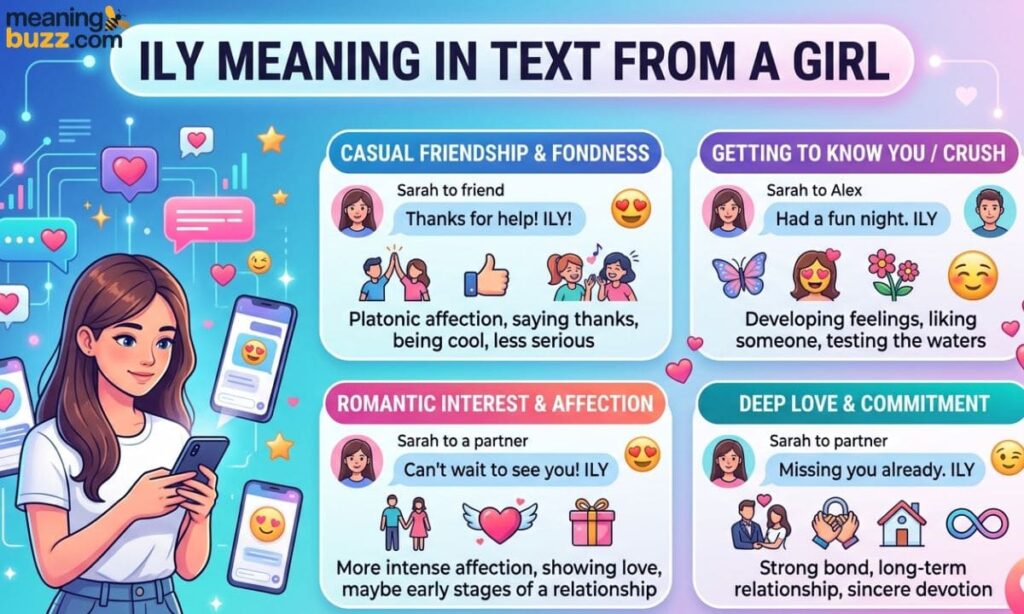
Girls tend to use ILY more freely across both platonic and romantic relationships, which can sometimes cause confusion.
- To a close friend: ILY is often a natural sign-off between girlfriends. It does not always carry romantic weight.
- To a partner: It carries the full emotional meaning of “I love you” — sincere and heartfelt.
- In a new relationship: If a girl texts ILY early on, she likely means “I really like you” or “you make me happy” — a softer, warmer version of the phrase.
Usage in Various Contexts
Romantic Relationships
ILY fits naturally into daily couple conversations. It keeps the love alive between longer, more detailed expressions of affection. A simple “good morning, ILY” carries genuine warmth.
Friendships
Among friends, ILY is comfortable, warm, and non-romantic. Best friends say it to each other regularly without any confusion about what it means.
Family
Parents, siblings, and relatives use ILY in texts to stay connected. It is especially common in families that are comfortable with open emotional expression.
Social Media
On platforms like Instagram and TikTok, ILY appears in comments and captions as a casual compliment or expression of appreciation — “this made my day, ILY!”
Common Misconceptions & Clarifications
- “ILY always means romantic love.” Not true. It is used just as often between friends and family members.
- “ILY in text is not as meaningful as saying it in person.” For many people, saying it in a message takes just as much courage — especially early in a relationship.
- “ILY and ILYSM mean the same thing.” They do not. ILYSM means “I Love You So Much” and carries stronger emphasis.
- “If someone texts ILY, they expect a serious response.” Not always. Match the tone of the conversation.
Similar Terms & Alternatives
| Term | Full Form | Emotional Intensity |
| ILY | I Love You | High |
| ILU | I Love You | High (same, just variation) |
| ILYSM | I Love You So Much | Very High |
| ILYM | I Love You More | Playful / High |
| ILYA | I Love You All | Group / Casual |
| LY | Love You | Moderate |
| 143 | I Love You (letter count) | Classic / Nostalgic |
| ❤️ | Love (emoji) | Light to Moderate |
How to Respond to ILY?
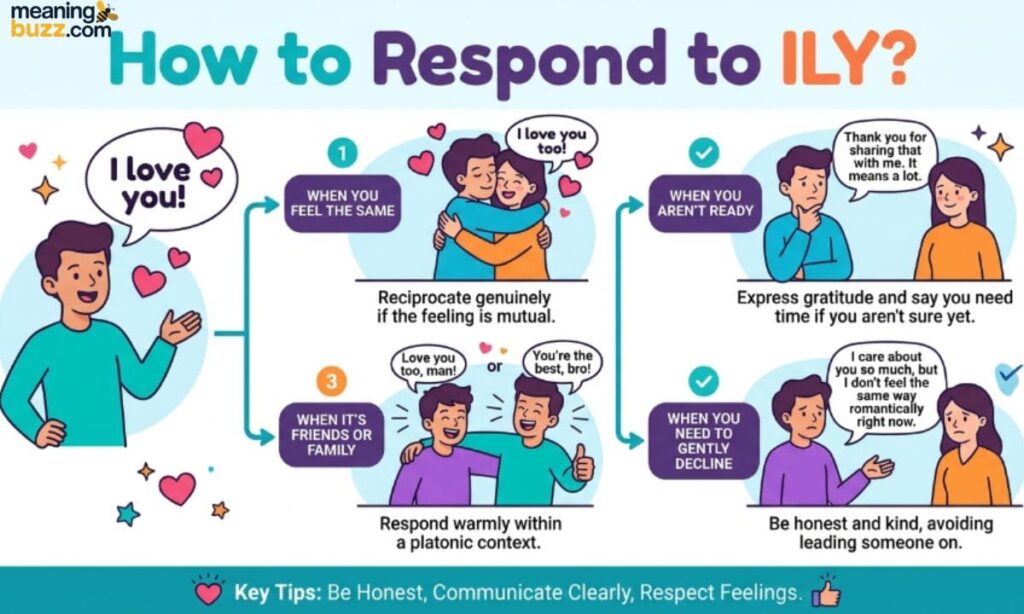
Your response should match the relationship and the tone. Here are natural options:
- Romantic response: “ILY too ❤️” or “I love you more 😘”
- Friendly response: “ILY bro!” or “Same, bestie!”
- Family response: “Love you too!” or a simple heart emoji
- If you are unsure: “That means a lot, thank you” keeps things warm without pressure
- If it feels too soon: A smiley or “you’re so sweet” gives a gentle, kind reply without committing
The key rule: never leave an ILY on read without any response. Even a short reply matters.
Regional or Cultural Differences
How people use ILY varies across regions:
- USA & UK: ILY is common in both romantic and platonic contexts. It flows easily in casual conversations.
- Asia: Younger generations use ILY frequently in online spaces, but older generations tend to prefer full written expressions of love.
- Middle East: Family-based expressions of affection are common in private messages, but public use of ILY is less typical due to cultural norms around emotional expression.
- Latin America: “ILY” is used alongside Spanish love expressions, often mixed in bilingual texts.
Comparison with Similar Terms
ILY vs. ILU: Both mean “I Love You.” ILU uses “U” instead of “Y” — equally casual, just a different spelling preference.
ILY vs. LY: LY (Love You) is lighter and less intense. You might end a message with “LY!” casually, while ILY carries slightly more weight.
ILY vs. ILYSM: ILYSM is the amplified version. Use it when ILY alone does not feel like enough.
Usage in Online Communities & Dating Apps
On dating apps like Tinder, Hinge, and Bumble, ILY is rare in early conversations — it signals strong emotion, which can feel overwhelming too soon. It tends to appear after a connection has developed over days or weeks.
In gaming communities and Discord servers, ILY shows up between close online friends after a great session, a kind gesture, or a funny moment. It is almost always platonic in those spaces.
On TikTok and Twitter, ILY appears in fan culture constantly — fans direct it toward creators they love or use it in comments when something genuinely moves them.
Hidden or Offensive Meanings
In standard everyday use, ILY carries no offensive meaning whatsoever. However, one lesser-known alternative meaning — “I’m Leaving You” — can cause real confusion if someone sends it during an argument. The context usually makes the difference clear, but if you are unsure, asking for clarification is always the right move.
There are no culturally offensive uses of ILY in mainstream digital communication.
Suitability for Professional Communication
ILY is not appropriate for professional or formal settings. It is casual internet slang, and using it in work emails, business messages, or formal correspondence can seem unprofessional or create awkward misunderstandings.
In a workplace context, stick to clear and respectful language. Save ILY for personal conversations where the emotional tone is already established.
Frequently Asked Questions
What does ILY mean in text?
ILY stands for “I Love You” — the most common and widely understood meaning across all platforms.
Is ILY used for friends or only for romantic partners?
Both. ILY is used freely between close friends, family members, and romantic partners.
What is the difference between ILY and ILYSM?
ILYSM means “I Love You So Much” — it adds extra emotional emphasis beyond a standard ILY.
What does ILY3 mean?
ILY3 means “I Love You ❤” — combining the acronym with a sideways heart created by the number 3.
Is ILY formal?
No, it is casual slang and should not be used in professional or formal communication.
How do I respond if I am not ready to say ILY back?
A warm reply like “that means a lot” or a simple smiley keeps the response kind without pressure.
Does ILY always mean romance?
Not at all. It is just as commonly used in platonic friendships and family conversations.
Conclusion
ILY packs a lot of heart into just three letters. Whether it lands in a late-night text from a partner, a quick message from your best friend, or a sweet comment on a social media post, the emotion behind it is real — and that is exactly why it has lasted so long in digital communication.
The most important thing to remember is context. ILY is flexible, warm, and personal. Use it when you mean it, respond to it kindly, and you will never go wrong. In a world of constant scrolling and short messages, three little letters can still say everything.