You’re scrolling through Instagram, someone drops “ion care” in the comments, and your brain goes straight to chemistry class. But wait — that’s not what they mean at all. If this sounds familiar, you’re definitely not alone. ION is one of the most searched texting abbreviations right now, and it trips people up because it doesn’t look like typical slang.
This guide explains exactly what ION means in text, where it came from, how it’s used across different platforms, and what to say when someone sends it your way.
Meaning & Definition
ION in text means “I don’t.”
It’s a phonetic slang term — written the way it sounds when someone says “I don’t” quickly in casual speech. Instead of typing two words, people just type three letters. Simple, fast, expressive.
Quick breakdown:
- Full meaning: I don’t
- Type: Phonetic slang / internet abbreviation
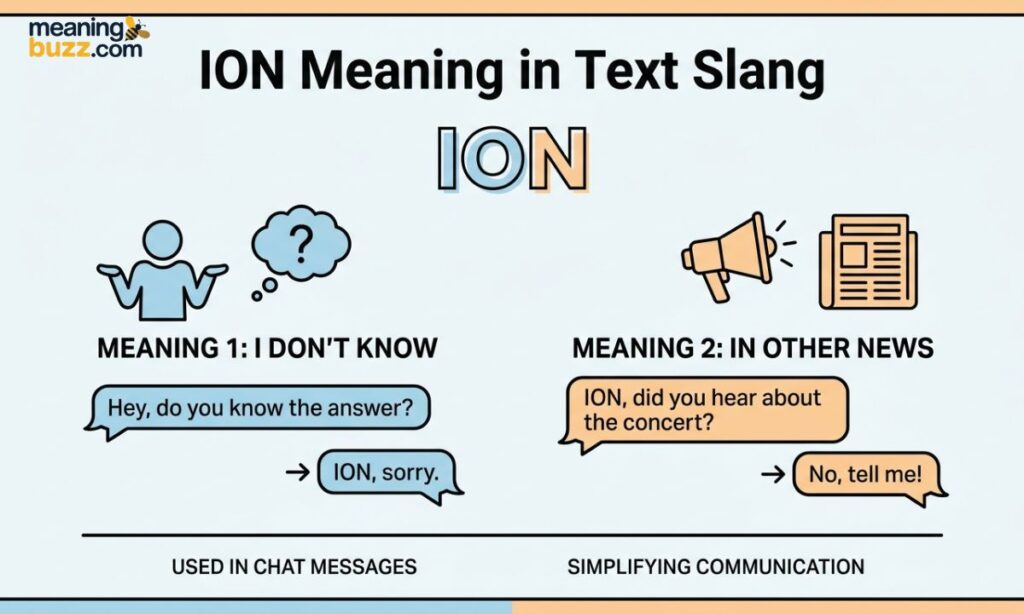
- Secondary meaning: “In Other News” (older usage)
- Used in: Casual texting, social media, DMs, comments
ION Meaning in Text Slang
ION is not a traditional acronym where each letter stands for something. It’s a phonetic contraction — the written version of how “I don’t” sounds when spoken at normal conversational speed. Say “I don’t” quickly out loud. Notice how it compresses into something that sounds a lot like “ion.” That’s exactly how this slang was born.
In modern digital communication, it’s used to express:
- Disagreement: “ion like that”
- Lack of knowledge: “ion know what you mean”
- Indifference: “ion even care anymore”
- Refusal: “ion want to go out tonight”
Background — Where Did ION Come From?
ION’s slang roots trace back to African American Vernacular English (AAVE), where “I don’t” is naturally spoken with a fast, compressed pronunciation. As texting culture grew, people started spelling words exactly how they sounded in real conversation — giving rise to forms like “ion,” “ain’t,” and “lemme.”
Here’s how the term evolved:
- Pre-2018 — Used in AAVE speech; not yet a widespread written form
- 2018–2020 — Spread through Black Twitter and early TikTok culture
- 2020–2022 — Went mainstream across Gen Z social media platforms
- 2023–2026 — Now a globally recognized piece of internet slang
It’s worth acknowledging: ION slang has cultural roots. Using it respectfully and being aware of its AAVE origins matters.
Usage in Different Contexts
ION fits naturally into many types of conversations. Here’s how context shapes its meaning:
| Context | Example | Translation |
| Casual texting | “Ion think so” | I don’t think so |
| Social media comment | “Ion care about drama” | I don’t care about drama |
| Gaming chat | “Ion got heals rn” | I don’t have heals right now |
| Dating app | “Ion like playing games” | I don’t like playing games |
| Topic shift (older use) | “ION, did you see the game?” | In Other News… |
The “In Other News” meaning is older and mostly seen on platforms with mixed age groups like Twitter/X or Facebook. On TikTok and Snapchat, it almost always means “I don’t.”
ION Meaning in Text From a Girl
When a girl texts you “ion,” the meaning is the same — it’s casual slang for “I don’t.” But tone matters a lot here. The phrase she pairs it with tells the real story.
- “Ion know, maybe” — she’s being playful or uncertain
- “Ion wanna talk rn” — she needs space
- “Ion like that for you” — she’s expressing care or concern
- “Ion wanna talk to anyone else but you” — this one leans flirty
Context, emoji usage, and the flow of the conversation are your best clues. ION itself is neutral — it’s the surrounding message that carries the emotion.
What Does ION Mean on Snapchat?
On Snapchat, ION means “I don’t” — no exceptions. Snapchat’s fast-paced, casual communication style makes this slang a perfect fit. You’ll see it in:
- Quick snap replies: “ion feel like it today 😭”
- Story responses: “ion even know what happened”
- Group chats: “ion care, just pick a restaurant”
The informal, spontaneous nature of Snapchat is why this slang thrives there.
Also read ETA Mean in Text Explained Simply—Just for You (2026)
ION Meaning in Chat, WhatsApp, Instagram, and TikTok
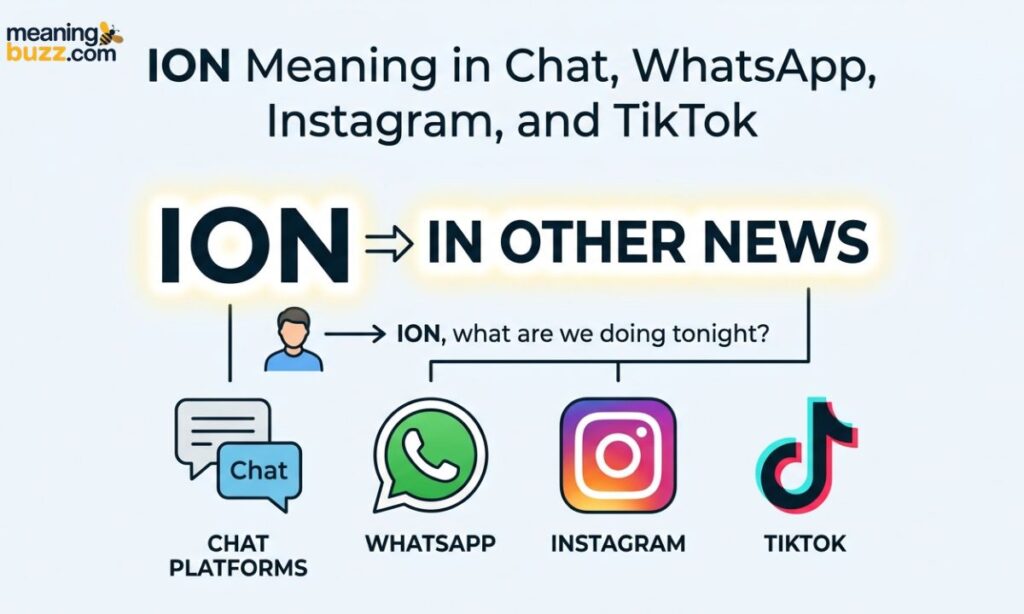
ION behaves slightly differently depending on the platform:
- WhatsApp — Used between friends and in group chats. Very common in casual back-and-forth conversations. “Ion think I can make it tonight.”
- Instagram — Appears in DMs, captions, and comment sections. Often paired with emotional or humorous content. “Ion really vibe with this one.”
- TikTok — Heavily used in comments and video captions, especially by Gen Z. Adds attitude and humor. “Ion know why I keep doing this 💀”
- Twitter/X — Mixed usage. Younger users say “I don’t”; older users may still use it as “In Other News.”
ION Meaning in Physics, Medical, and Other Fields
Outside of texting, “ion” has a completely different — and very scientific — meaning:
- Physics/Chemistry — An ion is an atom or molecule that carries an electric charge after gaining or losing electrons. Positive ions are called cations; negative ions are called anions.
- Medical — Ions like sodium, calcium, and potassium play essential roles in nerve function, muscle contractions, and overall body chemistry.
- Aviation — ION is not a standard aviation term, though the Greek letter eta (η), related to efficiency, sometimes appears in aeronautical formulas.
- Electronics/Engineering — Ion technology is used in batteries, ion propulsion systems, and semiconductor manufacturing.
So if someone in a science class says “ion” — they’re talking about charged particles, not slang. Context tells all.
“ION Know” Meaning in Text
“Ion know” is one of the most common phrases using this slang. It simply means “I don’t know.”
Used to express:
- Uncertainty: “Ion know if I’m going yet”
- Confusion: “Ion know what you mean by that”
- Indecision: “Ion know, what do you think?”
It’s relaxed, non-committal, and very natural in casual digital conversations.
“ION Care” Meaning in Text
“Ion care” means “I don’t care.”
This phrase can come across differently depending on tone:
- Neutral: Just saying something isn’t a big deal to them
- Playful: Used humorously, often with an emoji
- Dismissive: Can sound a bit cold if the context is tense
Example: “Ion care what people think about me” — This is usually an expression of confidence, not rudeness.
Common Misconceptions About ION
A few things people frequently get wrong:
- “It’s a typo” — No. ION is a deliberate phonetic spelling, not a mistake.
- “It’s about chemistry” — In texting, it has nothing to do with atoms or electrons.
- “It’s always rude” — Not true. Tone and context determine whether it sounds dismissive or casual.
- “It only means ‘In Other News'” — That’s an older usage. In 2026, “I don’t” is the dominant meaning, especially on TikTok and Snapchat.
Similar Terms & Alternatives
| Term | Meaning | Similarity to ION |
| IDK | I don’t know | Similar casual denial |
| IDC | I don’t care | Same emotion as “ion care” |
| IK | I know | Opposite acknowledgment |
| NGL | Not gonna lie | Honest, casual tone |
| TBH | To be honest | Same relaxed vibe |
| FR | For real | Emphasis, often paired with ION |
How to Respond to ION?
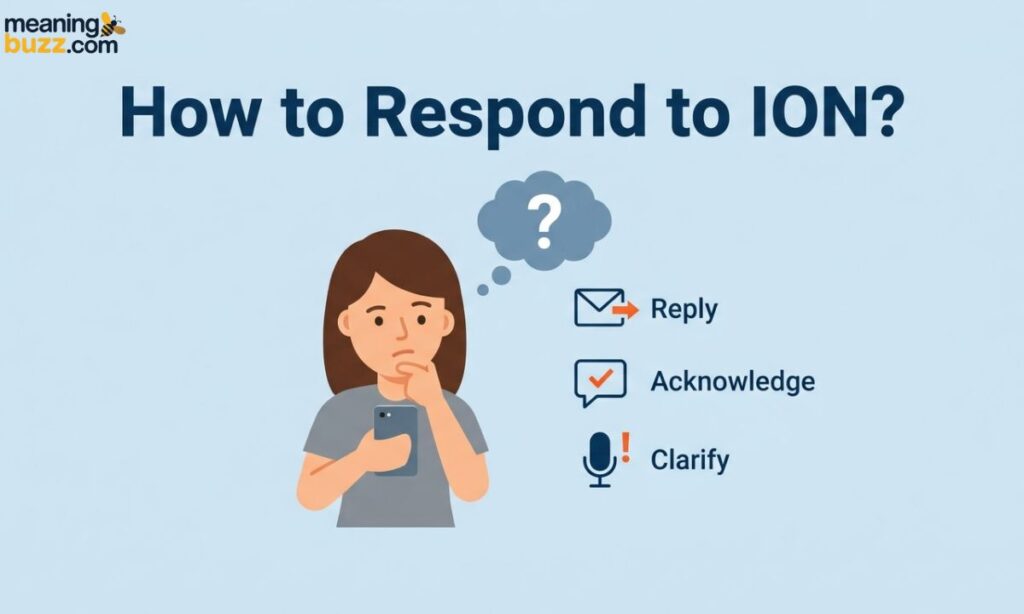
Your response depends entirely on what follows “ion” in the message:
- If someone says “ion know” → Reply with info or “That’s okay, no worries”
- If someone says “ion care” → Keep it light: “Fair enough” or “lol okay”
- If someone says “ion think so” → Ask why or say “All good!”
- If the tone seems off → Check in: “You okay?”
Match the energy. If it’s casual, keep it casual.
Differences from Similar Words
- ION vs IDC — Both express indifference, but ION is broader (“I don’t”) while IDC is specifically about not caring.
- ION vs IDK — IDK is a traditional acronym; ION is phonetic. Both express uncertainty but feel different stylistically.
- ION vs NGL — ION is a denial/refusal; NGL is an admission or honest statement.
- ION vs IK — Direct opposites. ION = “I don’t know”; IK = “I know.”
Relevance in Online Conversations & Dating Apps
On dating apps, ION adds personality and honesty to messages. “Ion like small talk — tell me something real” comes across as confident and direct. It signals you’re informal, expressive, and digitally fluent — which many people find appealing.
In broader online spaces, ION is a social identity marker. Using it signals you’re plugged into Gen Z digital culture. It keeps conversations moving quickly and creates a sense of shared language between people who text the same way.
Frequently Asked Questions
What does ION mean in a text message?
ION means “I don’t” — a phonetic slang shortcut commonly used in casual texting and social media.
Does ION always mean “I don’t”?
Almost always in casual digital spaces. An older usage means “In Other News,” but this is rare in 2026.
What does “ion know” mean in text?
It means “I don’t know” — used to express uncertainty, confusion, or indecision.
What does “ion care” mean in a message?
It means “I don’t care” — usually casual or playful, though tone affects how it lands.
Is ION rude to use?
Not inherently. It’s casual slang. Rudeness depends on the phrasing and context around it.
Where did ION slang come from?
It originated from African American Vernacular English (AAVE), where “I don’t” is spoken quickly and sounds like “ion.”
Can I use ION in professional messages?
No — ION is strictly informal. Stick to full phrases in work emails or formal communication.
What does ION mean in science?
In chemistry and physics, an ion is an atom or molecule that carries an electric charge due to gaining or losing electrons — completely unrelated to the texting slang
Conclusion
ION is three letters with real conversational weight. In texting and on social media in 2026, it almost always means “I don’t” — a phonetic slang term rooted in AAVE that spread through TikTok, Instagram, Snapchat, and everyday group chats. Whether someone says “ion know,” “ion care,” or “ion think so,” you now know exactly what they mean and how to respond.
Use it in casual settings, stay aware of its cultural roots, and skip it in professional conversations. That’s the full picture.